



Staking Platform Development

Ethereum, BNB Chain, Polygon, Tron, TON and EVM-compatible networks

web dashboard for users and an admin panel for pool configuration

audited smart contracts with reward logic verified before mainnet

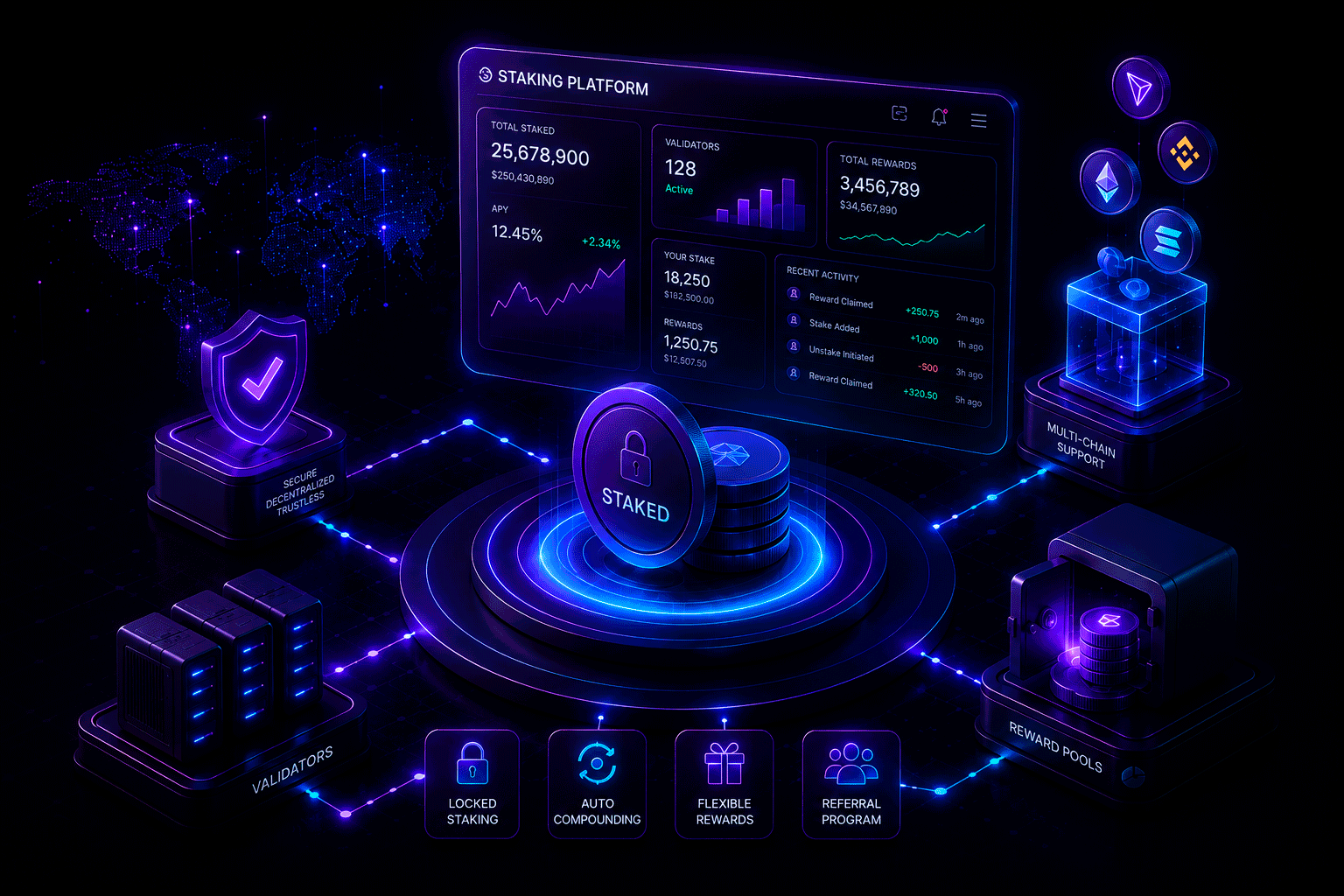
We build staking platforms that hold real value safely — flexible and locked staking, reward pools, auto-compounding, and referral mechanics, on the chain of your choice.
Referral and Loyalty Mechanics
Multi-level referral rewards and tier systems that increase retention without extra token emission.
07
Liquid Staking

Issue a derivative token against staked assets so users keep liquidity while earning rewards.
05
NFT Staking
Stake NFTs for token rewards, with rarity-weighted rates and collection-level configuration.
06
Admin Panel and Analytics
Configure pools, adjust rates, monitor TVL and user activity, and export reports without touching the contracts.
08
Flexible Staking
Deposit and withdraw at any time, with rewards accrued per block or per second and no lock-up commitment.
01
Validator and Delegated Staking
Delegation interfaces for proof-of-stake networks, including validator selection and reward distribution.
04
Locked Staking
Fixed-term pools with tiered APR, early-exit penalties, and automatic principal release at maturity.
02
Auto-Compounding Vaults
Rewards reinvested automatically on a schedule, with configurable performance and management fees.
03

Staking Platform Features

Everything you need to build a secure, scalable, and engaging staking platform — from flexible pools and liquid staking to analytics, referrals, and validator management.

Why Choose CryptoSoftLab for Staking Platforms

Reward Math That Holds
We model emission and APR against realistic TVL scenarios before writing code. Most failed staking products die from unsustainable reward rates, not from bugs.
Staking contracts hold user funds. Every contract is unit-tested, run through static analysis, and prepared for independent audit before mainnet deployment.
Security First
You get the smart contracts, the user-facing dashboard, wallet integration, and an admin panel — a working product, not a repository.
Full Product, Not Just Contracts
Written specification before development, access to the project tracker, and monthly progress reports against the roadmap.
Transparent Process
Launch
We perform the final setup and integrate the product with the required systems. We then deploy the project online or publish it on selected platforms.
07
Testing
We test the product functionality, verify the correct display of information, and fix any potential issues.
05
Support
After the project launch, we provide technical support, assist with any arising issues, and train your staff if necessary.
08
Approval
We present the project, provide access for independent testing, and refine the product based on your feedback.
06

How We Build Staking Platforms

From initial strategy and architecture to deployment and long-term support, we follow a structured development process for every staking platform.
Consultation
We thoroughly discuss the business goals, project concept, design, technical requirements, desired outcome, and reference examples.
01
Development
We carry out the development process in accordance with the approved technical documentation and project roadmap.
04
Evaluation
We assess the project complexity, cost, and development timeline. We select the optimal turnkey blockchain development solution for your business.
02
Documentation
We prepare, coordinate, and sign the complete set of documents: contract, NDA, technical specification, and project roadmap.
03

Staking Platform Development Cost

The price depends on the staking model, the number of supported networks, and whether you need a full user dashboard or only contracts.

Staking contract only (single pool, one chain) — from $4,000
Staking platform with dashboard and admin panel — from $15,000
Multi-pool platform with referral system — from $25,000
Multi-chain or liquid staking platform — from $45,000

Each quote includes testing, deployment, and source verification. Request a free estimate — we reply within one business day.

Technologies We Use

We use proven blockchain technologies, modern development frameworks, and security tools to build reliable, scalable, and production-ready staking platforms.
Security
Backend and data
Frontend
Networks
Contracts

Who Orders Staking Platforms

Web3 startups
Launch staking as the core product, with pools, referral mechanics, and analytics from day one.
GameFi and NFT projects
NFT staking and in-game reward pools that give collections ongoing utility after mint.
Exchanges and wallets
Add earn products to an existing platform so users keep assets in your ecosystem rather than moving them out.
Token projects
Reduce circulating supply and reward long-term holders instead of relying on exchange incentives.
Discover the businesses and Web3 ecosystems that use staking platforms to increase user retention, expand product offerings, and create long-term value.

Recent Staking Projects

Explore recent staking solutions delivered for token ecosystems, NFT collections, and Telegram-based Web3 products.
TON staking contract

with auto-compounding for a Telegram-based product
TON
NFT staking module

for a collection of 5,000 items, rarity-weighted rewards
NFT
Multi-pool staking platform

platform with referral system — launched in 10 weeks
MULTI-POOL
Frequently Asked Questions

How much does it cost to build a staking platform?

A staking contract alone starts from $4,000; a full platform with dashboard and admin panel from $15,000. See the pricing section for typical ranges.

How long does staking platform development take?

A single-chain MVP takes 8–12 weeks. Multi-chain or liquid staking platforms take 4–6 months including audit.

Are the staking contracts audited?

Every contract is unit-tested and passes static security analysis before deployment. For platforms holding significant value we recommend and can arrange an independent audit.

Can users lose their staked funds?

Staking contracts are non-custodial: funds stay in the contract and are withdrawable under the rules you define. Risk comes from contract bugs and reward design, which is exactly what testing and audit address.

Which networks do you support?

Ethereum and EVM-compatible chains (BNB Chain, Polygon, Arbitrum, Base), plus Tron and TON.

Can you add staking to our existing token?

Yes. We build staking contracts around tokens that are already deployed, without requiring a migration.

Staking Platform Development Company

Staking has become the default way for token projects to reward holders and reduce sell pressure. It is also one of the most demanding things to build correctly: the contract holds user funds, the reward math has to stay solvent under changing TVL, and the interface has to make all of it understandable to people who are not developers.

CryptoSoftLab builds staking platforms as complete products. We begin by modelling the reward economics — emission rate, expected TVL, lock periods, and how the pool behaves when deposits spike or drain. Only after the model holds do we write the contracts, cover them with unit and fork tests, run static analysis, and deploy to testnet for your approval. The user dashboard, wallet integration, and admin panel are delivered alongside, so you launch with a working product rather than a set of contract addresses.

We work with token projects, exchanges, wallets, and GameFi teams across the United States, the United Kingdom, the UAE, Singapore, and Europe. A single-pool staking contract starts from $4,000; a full platform with dashboard and admin controls starts from $15,000.
Describe the staking model you have in mind — flexible, locked, liquid, or NFT-based — and we will come back with an approach, timeline, and fixed quote within one business day.

Tell us what staking model you need — we'll reply within one business day with an estimate and timeline.

Discuss Your Staking Platform

By submitting this form, you agree to our Privacy Policy

Related Services

Complete your staking platform with complementary blockchain development services designed to support your entire Web3 ecosystem.